
(07) 4658 0600

More wildlife, biodiversity detected at emerging springs

Feb 17, 2023GAB, News

Our focus at this time of the year (Feb-March) is assessing outcomes that come with good rainfall.

And with plenty of revisits to our monitoring sites across the Desert Channels region, you’ll be sure to see plenty of DCQ vehicles around!

This year, widespread rain and regular follow-up rainfall means changes to our emerging springs are happening very quickly.
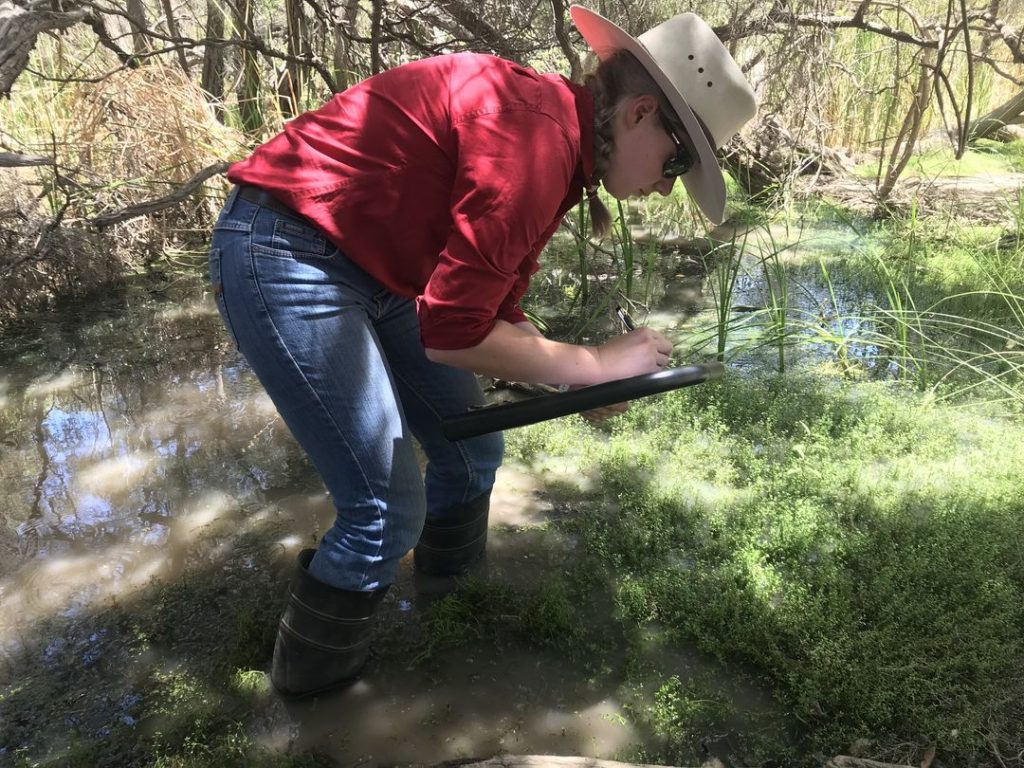
A DCQ officer stands in the shallow waters of an emerging spring as she monitors and takes notes on a clipboard.

 DCQ Officer Natalie Pearce conducts spring monitoring in the Desert Channels region.

At one of our main spring recovery sites, we now have over 72 per cent of Rubber Vine removed thanks to the hard work of our DCQ Field Team and landholders.

More water, more springs

Thanks to DCQ’s recent watertightening and bore capping project, we have also recorded the re-emergence of dozens of new springs across properties in the Great Artesian Basin.

We have now recorded 109 species at spring sites, including four “conservation-listed” species and two species that are undergoing further study to confirm whether they are yet to be described.

In addition to this, new records have been submitted to expand the “known range” of certain species in the Desert Channels region.

Exciting stuff – and a great outcome that again demonstrates that conservation and primary livestock production can co-exist effectively.

CITIZEN SCIENCE A WRAP

This project aims to build community understanding for our local environment and to spark an interest in science.

Herbicide trial underway to control ‘worst’ woody weeds

A herbicide that mixes with water instead of diesel is being tested on Parkinsonia, Mesquite and Prickly Acacia in the Desert Channels region.

Succulent ‘crack-down’ on Mother of Millions as surveys kick on

Mother of millions have spread aggressively near Blackall, but a new project will help mop it up.

How poly-pipe squares help assess land ‘bio-condition’ over time

A square plays a important role in capturing changes in NRM condition for several projects in the DCQ region.

Night parrot listed as ‘critically endangered’ as monitoring underway

An elusive, rare parrot in the Desert Channels region that was once thought to be extinct.

Free water quality testing of bores, springs in Western Queensland

Over the next 12 months, DCQ can test your bore or spring water quality at no cost.

Photos: Fast-moving bushfires a ‘real possibility’ in Western Qld this season

The Qld Rural Fire Service is concerned fires will be more dangerous than usual.

More funding to cap and pipe bores announced for Queensland

Up to 90% of your estimated eligible project costs could be covered. 

Prickly Acacia

Funded by the Commonwealth Government, the project aims to improve property planning to ensure that the current threats to springs are reduced.

Waddy Trees

Occurring in isolated populations on the fringe of the Simpson Desert in inland Australia, the Waddi tree is one of the country’s rarest trees.

Land Condition

Restoring and revegetating bare ground country that has been barren for decades.

Feral Pigs

Feral pigs devastate environmental, livestock and natural resources, and only a targeted and coordinated control effort will keep numbers down for good.

GAZING AND GRAZING INTO THE FUTURE

A project dedicated to assisting the progression of the grazing industry into the future is one that deserves close attention and support from all involved in the industry. One of 10 projects under the Queensland Government’s Drought and Climate Adaptation Program...

THE TECH SAVY DESERT RAT

iPads are not just toys for us. They’ve become critical tools in recording our data and helping us to refine our mapping.

SUCCESS IN THE MAKING

With the summer rain, plants are now leaping out of the ground.

IS DIESEL BECOMING A THING OF THE PAST?

The increased cost of diesel, along with its health and environmental issues, has opened the door for a new kind of herbicide.

SEEDY BUSINESS

Sometimes, even mother nature needs a hand. Having perfected Prickly Acacia control, we have begun seeding work to “turbo charge” pasture recovery.

THORNVILLE QUANDARY

When pastures don’t return as expected.