
(07) 4658 0600

THE TECH SAVY DESERT RAT

Feb 15, 2022Featured, News

“Give a man an iPad and you amuse him for a day. Teach a man to use an iPad and you give him work for a lifetime” – ancient DCQ proverb.
DCQ Field Supervisor, Peter Spence, is one of those blokes who decided to keep up with the ‘modern technology’.
 
Spending most of his life in the Desert Uplands, north of Muttaburra, it’s only in the last ten years that Pete has really had the opportunity to cover the whole of the region as part of the DCQ team.
 
He, like all our staff, possesses a broad set of skills that is combined with practical science and applied across a range of projects.
 

Team out, data in

Pete’s time is spent liaising with our landholders and coordinating the work of the field team but also, crucially, he is part of the team of people who measure the outcome of the projects we do, which provides the learnings we apply.
 
iPads are not just toys for us. They’ve become critical tools in recording our data and helping us to refine our mapping.
 
Now that this region has received some rain, landholders are reporting that their native pasture is finally poking its head up.
 
As the creeks subside and property roads are graded, DCQ staff are heading out to key sites to measure the recovery, learn from our research and development work, and look for emergent weeds.
 
As Peter and the team are out, data from our work sites is coming in as we help you invest in the natural resources of the Desert Channels region.
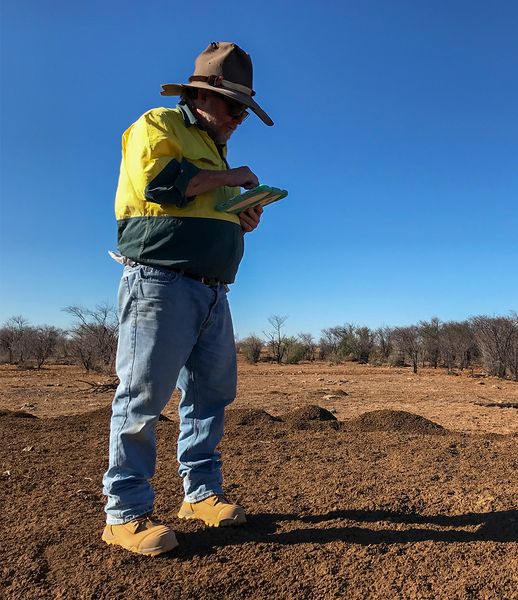
field officer on iPad

Bores and ‘bio-bugs’ at the Ayrshire Downs Field Day

Landholders gather at Ayshire Downs to discuss the latest DCQ projects from bore capping to bio-controls.

KOALA: A WELCOME RETURN…

At one of our work sites the DCQ field team and local landholders have been battling a huge infestation of rubber vine. This is the first time we have found a Koala in one of our work areas.

SEEDY BUSINESS

Sometimes, even mother nature needs a hand. Having perfected Prickly Acacia control, we have begun seeding work to “turbo charge” pasture recovery.

How poly-pipe squares help assess land ‘bio-condition’ over time

A square plays a important role in capturing changes in NRM condition for several projects in the DCQ region.

Night parrot listed as ‘critically endangered’ as monitoring underway

An elusive, rare parrot in the Desert Channels region that was once thought to be extinct.

Free water quality testing of bores, springs in Western Queensland

Over the next 12 months, DCQ can test your bore or spring water quality at no cost.

Photos: Fast-moving bushfires a ‘real possibility’ in Western Qld this season

The Qld Rural Fire Service is concerned fires will be more dangerous than usual.

More funding to cap and pipe bores announced for Queensland

Up to 90% of your estimated eligible project costs could be covered. 

Springs

Lying beneath parts of the Northern Territory, Queensland, South Australia, and New South Wales, the Great Artesian Basin, (GAB) is Australia’s largest groundwater basin and one of the largest underground freshwater resources in the world.

Invasive Cactus

Cactus weeds have become more aggressive in our region due to climate shifts, drought and rainfall variability.

Waddy Trees

Occurring in isolated populations on the fringe of the Simpson Desert in inland Australia, the Waddi tree is one of the country’s rarest trees.

Prickly Acacia

Funded by the Commonwealth Government, the project aims to improve property planning to ensure that the current threats to springs are reduced.

Emergency Plan

The BANC Emergency Preparedness and Response Plan outlines preparedness response and recovery actions for each asset with the aim of reducing the impact of catastrophic events.

SEEDY BUSINESS

Sometimes, even mother nature needs a hand. Having perfected Prickly Acacia control, we have begun seeding work to “turbo charge” pasture recovery.

THORNVILLE QUANDARY

When pastures don’t return as expected.

IS DIESEL BECOMING A THING OF THE PAST?

The increased cost of diesel, along with its health and environmental issues, has opened the door for a new kind of herbicide.

SUCCESS IN THE MAKING

With the summer rain, plants are now leaping out of the ground.