
(07) 4658 0600

Camels prefer Prickly Acacia – but what’s the overall trend?

Feb 17, 2023News, Trial

Monitoring has now recommenced on DCQ’s camel herd near Winton, now that it’s drying out a bit – with data due to be finalised in April!

The camels still have tags tracking their movement and the location “heat map” shows how they favour certain areas of a paddock over others.

An interesting insight from the end of last year’s monitoring showed that while the camels clearly favour Prickly Acacia trees, shrubs and broad-leafed forbes instead of grass, we’ve noticed that as this resource declines towards the end of the dry season, they’ve begun to compete with cattle for Mitchell grass.


This makes forage budgeting even more essential, and shows that camels are actually pretty smart.

Once the prickle bushes get very thick, we’ve noticed camels begin to move to areas with lower density.

This gives us further insights about the kinds of scenarios (e.g. somewhat sparse infestations) where camels would be most effective at controlling Prickly Acacia.

Once compiled, we aim to provide a much clearer understanding to landholders of how camels can be efficiently integrated into properties to help manage Prickly Acacia and compliment chemical control.

UPDATE: These results have been posted here.
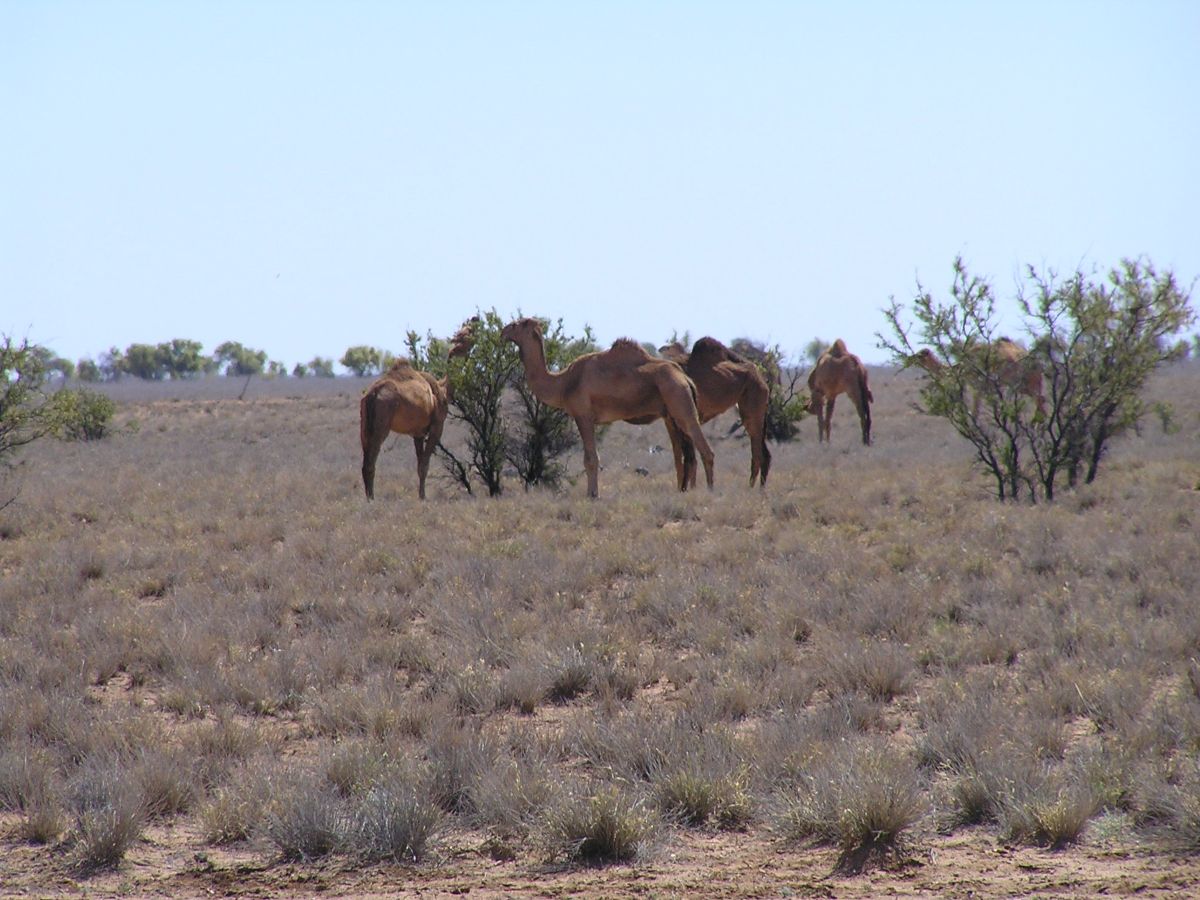
Camels chomp on prickly acacia trees in Western Queensland.

EDGBASTON GOBY MAKING A COMEBACK

A rare and threatened species, the Edgbaston Goby is making a comeback thanks to a new wetland built with funding from the DCQ Foundation.

IS DIESEL BECOMING A THING OF THE PAST?

The increased cost of diesel, along with its health and environmental issues, has opened the door for a new kind of herbicide.

Emerging springs a ‘success’ in the Great Artesian Basin

Some exciting results from an emerging springs project in the Desert Channels region.

How poly-pipe squares help assess land ‘bio-condition’ over time

A square plays a important role in capturing changes in NRM condition for several projects in the DCQ region.

Night parrot listed as ‘critically endangered’ as monitoring underway

An elusive, rare parrot in the Desert Channels region that was once thought to be extinct.

Free water quality testing of bores, springs in Western Queensland

Over the next 12 months, DCQ can test your bore or spring water quality at no cost.

Photos: Fast-moving bushfires a ‘real possibility’ in Western Qld this season

The Qld Rural Fire Service is concerned fires will be more dangerous than usual.

More funding to cap and pipe bores announced for Queensland

Up to 90% of your estimated eligible project costs could be covered. 

LANDCARE

Funded through the Australian Government’s National Landcare Program, the SAF is a trusted partner providing critical advice and extension services

Watertight

The Queensland Government has established the WaterTight program to be carried out by the Natural Resource Management groups

Emergency Plan

The BANC Emergency Preparedness and Response Plan outlines preparedness response and recovery actions for each asset with the aim of reducing the impact of catastrophic events.

Land Condition

Restoring and revegetating bare ground country that has been barren for decades.

HEAT

An environmental project focused on high value areas, properties that surround National Parks, or refugia that support crucial species migration in a changing climate.

SUCCESS IN THE MAKING

With the summer rain, plants are now leaping out of the ground.

SEEDY BUSINESS

Sometimes, even mother nature needs a hand. Having perfected Prickly Acacia control, we have begun seeding work to “turbo charge” pasture recovery.

THE TECH SAVY DESERT RAT

iPads are not just toys for us. They’ve become critical tools in recording our data and helping us to refine our mapping.

THORNVILLE QUANDARY

When pastures don’t return as expected.

IS DIESEL BECOMING A THING OF THE PAST?

The increased cost of diesel, along with its health and environmental issues, has opened the door for a new kind of herbicide.