
(07) 4658 0600

THE TECH SAVY DESERT RAT

Feb 15, 2022Featured, News

“Give a man an iPad and you amuse him for a day. Teach a man to use an iPad and you give him work for a lifetime” – ancient DCQ proverb.
DCQ Field Supervisor, Peter Spence, is one of those blokes who decided to keep up with the ‘modern technology’.
 
Spending most of his life in the Desert Uplands, north of Muttaburra, it’s only in the last ten years that Pete has really had the opportunity to cover the whole of the region as part of the DCQ team.
 
He, like all our staff, possesses a broad set of skills that is combined with practical science and applied across a range of projects.
 

Team out, data in

Pete’s time is spent liaising with our landholders and coordinating the work of the field team but also, crucially, he is part of the team of people who measure the outcome of the projects we do, which provides the learnings we apply.
 
iPads are not just toys for us. They’ve become critical tools in recording our data and helping us to refine our mapping.
 
Now that this region has received some rain, landholders are reporting that their native pasture is finally poking its head up.
 
As the creeks subside and property roads are graded, DCQ staff are heading out to key sites to measure the recovery, learn from our research and development work, and look for emergent weeds.
 
As Peter and the team are out, data from our work sites is coming in as we help you invest in the natural resources of the Desert Channels region.
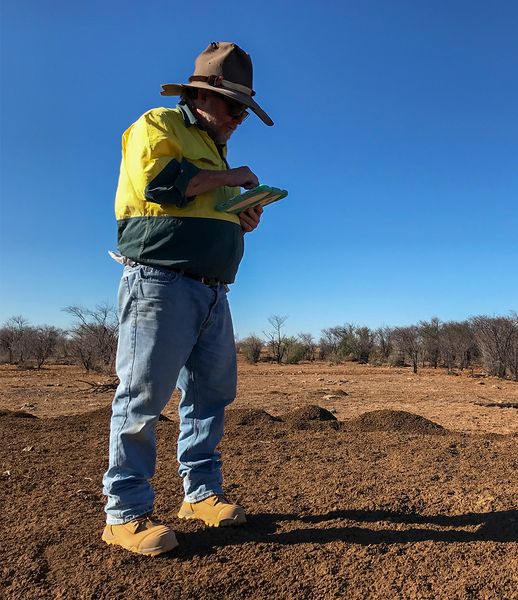
field officer on iPad

How poly-pipe squares help assess land ‘bio-condition’ over time

A square plays a important role in capturing changes in NRM condition for several projects in the DCQ region.

MAKING THE LAND MORE PRODUCTIVE: REHABILITATION AFTER DROUGHT

Controlling erosion and pasture rehabilitation: Daryl Hill gives practical demonstrations in workshops across the DCQ Region

GIDYEA THICKENING

We talk to Doug and Lauren Tindall from Janet Downs and Gaza. They discuss the problems they are having with Gidyea Thickening, the commercial cost of the spread and what they do in an attempt to keep ahead of it.

How poly-pipe squares help assess land ‘bio-condition’ over time

A square plays a important role in capturing changes in NRM condition for several projects in the DCQ region.

Night parrot listed as ‘critically endangered’ as monitoring underway

An elusive, rare parrot in the Desert Channels region that was once thought to be extinct.

Free water quality testing of bores, springs in Western Queensland

Over the next 12 months, DCQ can test your bore or spring water quality at no cost.

Photos: Fast-moving bushfires a ‘real possibility’ in Western Qld this season

The Qld Rural Fire Service is concerned fires will be more dangerous than usual.

More funding to cap and pipe bores announced for Queensland

Up to 90% of your estimated eligible project costs could be covered. 

HEAT

An environmental project focused on high value areas, properties that surround National Parks, or refugia that support crucial species migration in a changing climate.

Feral Pigs

Feral pigs devastate environmental, livestock and natural resources, and only a targeted and coordinated control effort will keep numbers down for good.

Land Condition

Restoring and revegetating bare ground country that has been barren for decades.

E-BEEF SMART FARM

A three-year project supporting primary-producers with technology to assist with timely and informed management decisions.

Prickly Acacia

Funded by the Commonwealth Government, the project aims to improve property planning to ensure that the current threats to springs are reduced.

SEEDY BUSINESS

Sometimes, even mother nature needs a hand. Having perfected Prickly Acacia control, we have begun seeding work to “turbo charge” pasture recovery.

SUCCESS IN THE MAKING

With the summer rain, plants are now leaping out of the ground.

IS DIESEL BECOMING A THING OF THE PAST?

The increased cost of diesel, along with its health and environmental issues, has opened the door for a new kind of herbicide.

THORNVILLE QUANDARY

When pastures don’t return as expected.