
(07) 4658 0600

EDGBASTON GOBY MAKING A COMEBACK

Mar 11, 2022DCF, GAB, News

A rare and threatened species is making a comeback in the Desert Channels region.

Students from Aramac State School got to “build” on their class learning program during a field visit to the property Ravenswood recently.

Here, a rare and threatened species, the Edgbaston Goby is making a comeback thanks to a new wetland built with funding from the DCQ Foundation.

The wetland site, constructed close to a bore drain which is one of the few remaining habitats of this small fish, is providing a breeding site free from predators.
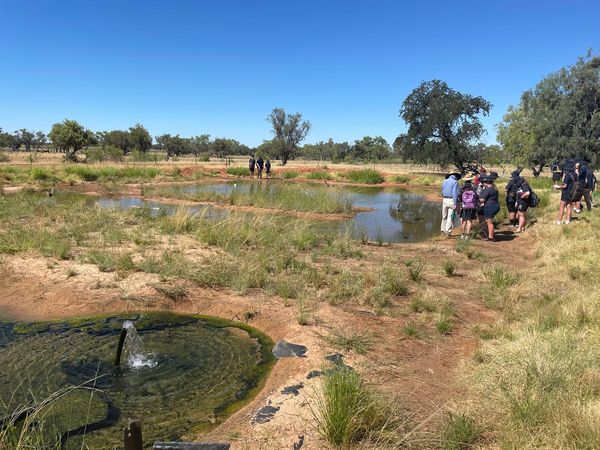
Students on field trip to wetland

Theory into practice

With only 610 adults left globally, the site is an important link in the recovery of this special fish, and is also providing additional habitat for rare plants also found at the site.

The students, from Year 7 to Year 10, had the opportunity to put “into practice” the theory they have been learning in school.

This includes seeing how ecosystems function in the wild and how – through careful planning and the contribution of many people – a positive impact can be made on the future of these special species.

The fact that it is occurring in their own backyard makes it extra special.

It is always a pleasure to host these kinds of events when we have such engaged and interested students. The future of science in the region certainly looks bright.

How poly-pipe squares help assess land ‘bio-condition’ over time

A square plays a important role in capturing changes in NRM condition for several projects in the DCQ region.

Night parrot listed as ‘critically endangered’ as monitoring underway

An elusive, rare parrot in the Desert Channels region that was once thought to be extinct.

Free water quality testing of bores, springs in Western Queensland

Over the next 12 months, DCQ can test your bore or spring water quality at no cost.

Photos: Fast-moving bushfires a ‘real possibility’ in Western Qld this season

The Qld Rural Fire Service is concerned fires will be more dangerous than usual.

More funding to cap and pipe bores announced for Queensland

Up to 90% of your estimated eligible project costs could be covered. 

Invasive Cactus

Cactus weeds have become more aggressive in our region due to climate shifts, drought and rainfall variability.

Springs

Lying beneath parts of the Northern Territory, Queensland, South Australia, and New South Wales, the Great Artesian Basin, (GAB) is Australia’s largest groundwater basin and one of the largest underground freshwater resources in the world.

Land Condition

Restoring and revegetating bare ground country that has been barren for decades.

PACT

Funded by the Commonwealth Government, the project aims to improve property planning to ensure that the current threats to springs are reduced.

GAZING AND GRAZING INTO THE FUTURE

A project dedicated to assisting the progression of the grazing industry into the future is one that deserves close attention and support from all involved in the industry. One of 10 projects under the Queensland Government’s Drought and Climate Adaptation Program...

SUCCESS IN THE MAKING

With the summer rain, plants are now leaping out of the ground.

IS DIESEL BECOMING A THING OF THE PAST?

The increased cost of diesel, along with its health and environmental issues, has opened the door for a new kind of herbicide.

THE TECH SAVY DESERT RAT

iPads are not just toys for us. They’ve become critical tools in recording our data and helping us to refine our mapping.

THORNVILLE QUANDARY

When pastures don’t return as expected.

SEEDY BUSINESS

Sometimes, even mother nature needs a hand. Having perfected Prickly Acacia control, we have begun seeding work to “turbo charge” pasture recovery.